Exhibition Review | Haitai Precision Technology Shines at the 5th Shenzhen Precision Ceramics and IGBT Industry Chain Exhibition
2023-08-31
The 5th Precision Ceramics and IGBT Industry Chain Exhibition came to a successful conclusion at Hall 8 of Shenzhen World Exhibition & Convention Center. As a testing equipment company focusing on AI machine vision and electrical performance as its core businesses, Shenzhen Haitai Precision Technology Co., Ltd. garnered extensive attention.
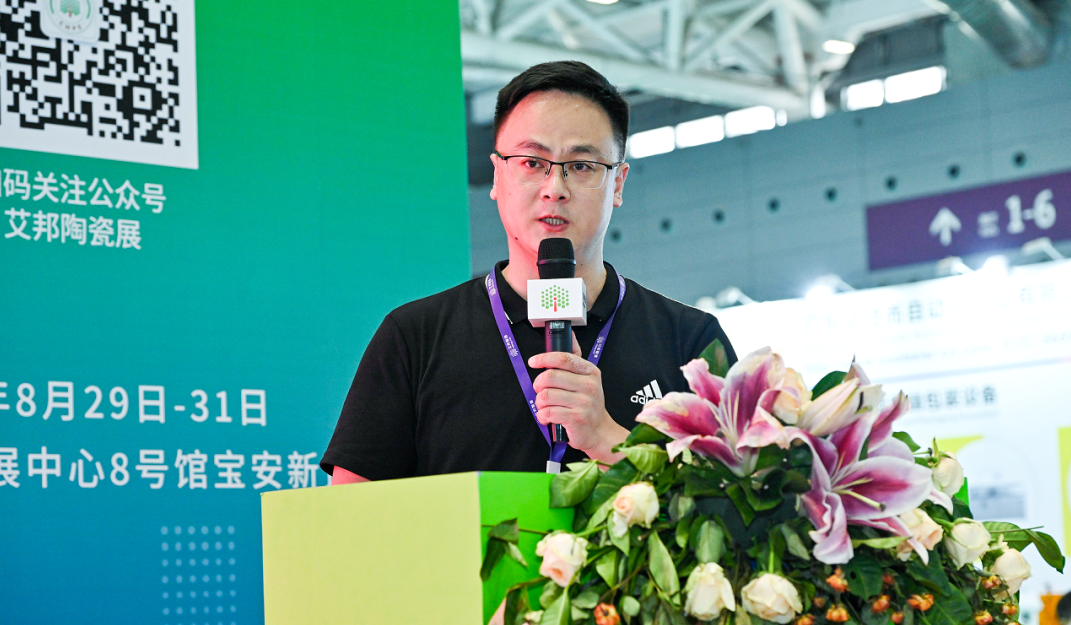
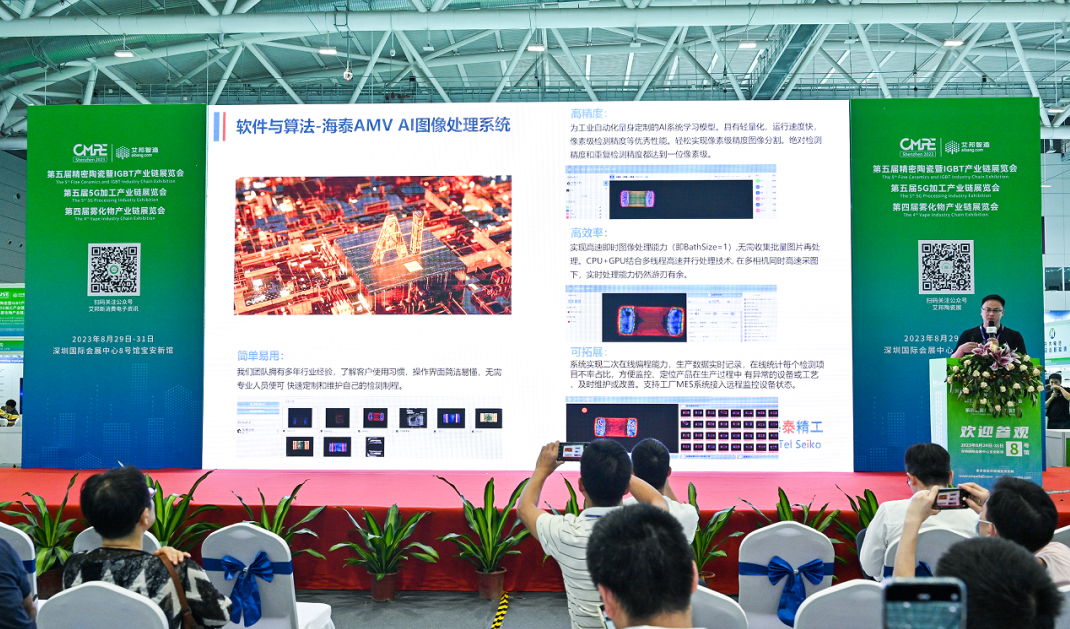
At the forum hosted by the industry, Pei Yanming, General Manager of Haitai Precision Technology, shared his insights regarding the company’s testing cases in the precision ceramics sector and the implementation of AI visual inspection.
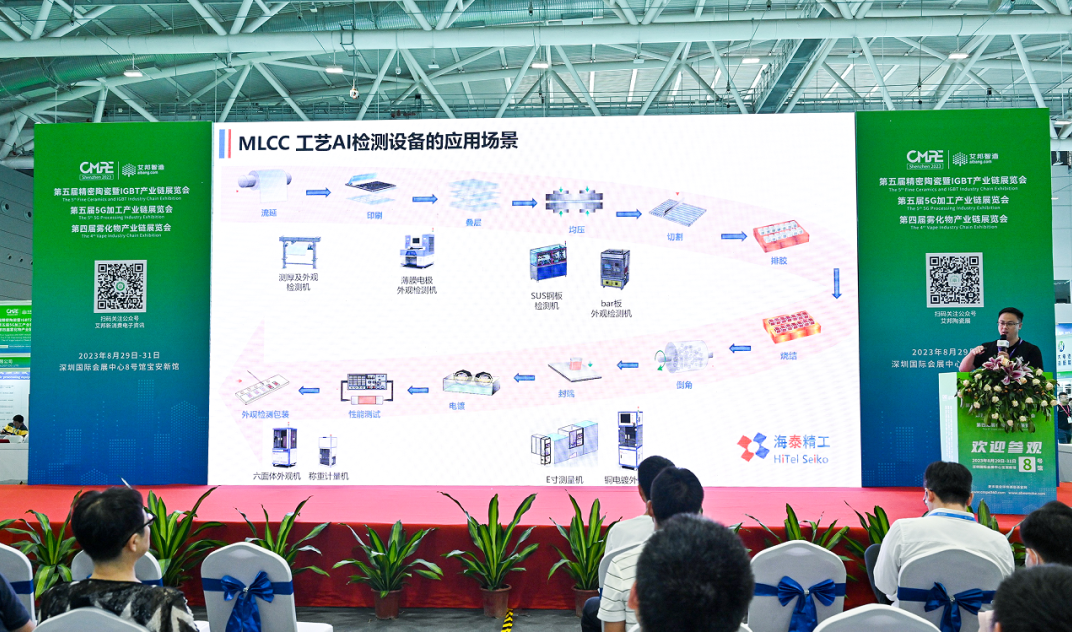
Currently, Haitai has made in-depth layout in machine vision technology for the MLCC manufacturing process within the precision ceramics industry chain. It has successfully delivered a full range of equipment to clients, covering detection scenarios across the entire production cycle:
Defect detection for film casting and electrode screen printing in the front-end process;
Foreign object detection for bar blanks and high-reflectivity steel plates used in bar blank pressing;
Copper plating inspection before silver application and through-hole inspection for silver-coated blanks;
Weight measurement, counting, and high-speed six-sided appearance inspection in the back-end process.
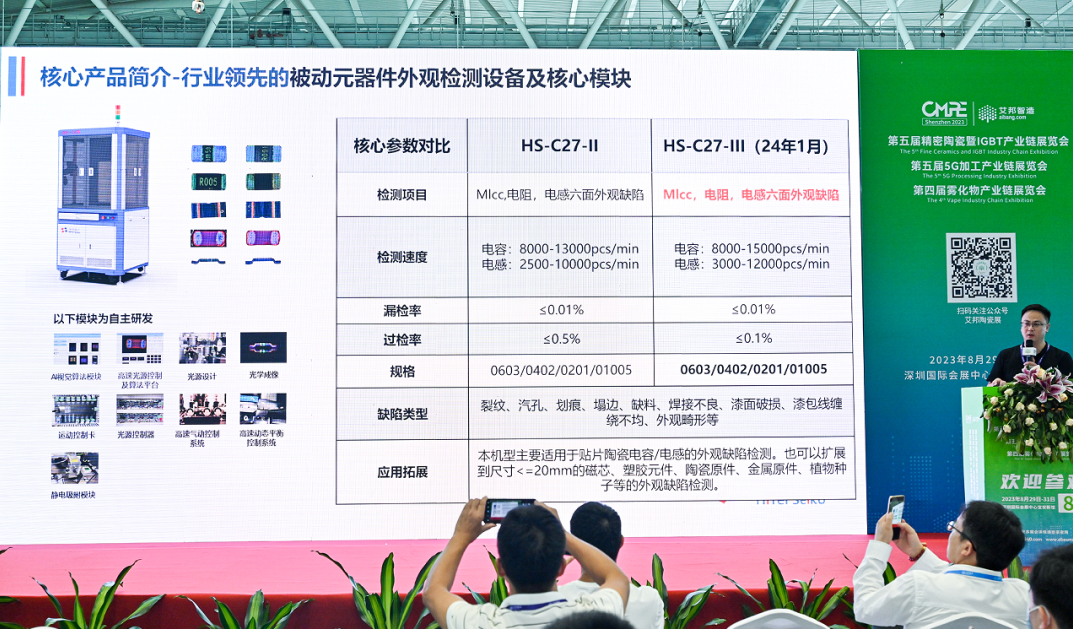
At present, Haitai’s six-sided visual inspection machine has also reached the industry-leading level. For the MLCC inspection equipment, it adopts the industry-leading high-definition image processing technology for defect detection, and the maximum speed can still reach 13,000 pcs/min.
Regarding the application of AI, Pei Yanming pointed out: “AI sounds fancy and sophisticated when mentioned in the market, but industrial AI inspection prioritizes practical implementation above all else. In this regard, Haitai has taken many detours and even attempted cooperation with numerous top AI companies in the market, yet none yielded satisfactory results. Only through the team’s years of accumulated experience, continuous verification, and reference to customer suggestions have we gradually refined a product that is better and more down-to-earth.
In my view, a superior industrial AI visual inspection system must meet four core criteria:
First, simplicity and ease of use. We must be well-versed in the industry and manufacturing processes, understand customer usage habits, and design a concise and intuitive operation interface. Even non-professional staff can quickly customize and maintain their own inspection processes without specialized expertise.
Second, high precision. As MLCC products become increasingly miniaturized, the requirements for inspection precision keep rising. Haitai’s AI system learning model is tailor-made for industrial automation, boasting outstanding features such as lightweight architecture, fast operation speed, and pixel-level inspection precision. It effortlessly achieves pixel-level image segmentation, with both absolute inspection precision and repeat inspection precision reaching single-pixel level.
Third, high efficiency. Visual inspection has now entered an era of speed competition. Haitai has achieved high-speed real-time image processing capability (i.e., BatchSize=1), eliminating the need to collect and process images in batches. Leveraging CPU+GPU combined multi-thread high-speed parallel processing technology, our system maintains effortless real-time processing even under simultaneous high-speed image capture by multiple cameras.
Fourth, scalability. The system supports secondary online programming, real-time recording of production data, and online statistics of defect rates for each inspection item—facilitating the monitoring and identification of abnormal equipment or processes during production for timely maintenance and improvement. It also enables connection to the factory’s MES system for remote monitoring of equipment status. Haitai is also piloting a model where multiple machines share a single server for AI model training.”
In addition, high-quality optical imaging is also a crucial component of inspection equipment. First and foremost, all of Haitai’s inspection equipment captures high-definition images and never sacrifices image quality for improved efficiency. We adopt RGB multispectral light sources, and have identified the optimal light source configuration for imaging through practical application. Moreover, our core light sources and controllers are independently researched and designed, ensuring optimal imaging performance and greater stability during high-speed flying capture.
Beyond that, Haitai has also developed proprietary technologies for high-speed control, electrostatic adsorption, material guiding and other critical details, with numerous standout features in these aspects. All these details directly contribute to the stability and speed of the equipment.
The exhibition has concluded, yet Haitai Precision’s journey has only just begun. Our voyage is bound for the stars and the sea!
 2023-08-31